Team Health

How your team actually operates, and a plan to improve it.
Best for:
Leadership teams
10–15 minute survey
Part of a facilitated engagement
WHAT IT MEASURES
A 38-question survey, completed by every team member, measures eight dimensions of team performance, including psychological safety, accountability, communication and results.
WHAT YOU GET
A Team Health score, a classification (High Performing, Developing, Emerging or Requiring Attention), a Team Type that describes how your team tends to operate, and flags showing where people’s experiences differ most.
HOW IT WORKS
Results are shared in a live workshop where the team builds an action plan with owners and due dates. Leaders who need support then receive individual coaching, and a reassessment about 90 days later shows what changed.
Team Health runs as a facilitated engagement, not a self-serve tool.
Learn more at Sonas Team Health
DISC Behavioral Profile
How people behave, communicate and respond under pressure.
Best for:
Communication, team friction, leading different styles.
10–15 minute online assessment.
One debrief session.
WHAT IT MEASURES
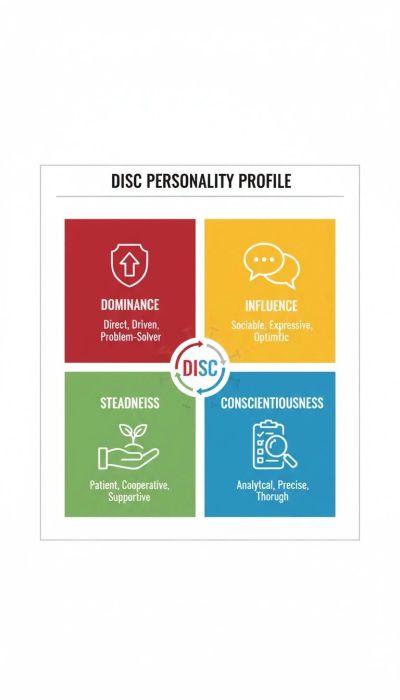
Behavioral style across four dimensions: Dominance (problems and challenges), Influence (people and contacts), Steadiness (pace and consistency) and Conscientiousness (rules and procedures). DISC describes how you behave, not your personality, intelligence or values.
WHY IT MATTERS
Style differences are a common source of friction in teams, and often an easy one to improve. DISC gives people a shared language for why they communicate and decide differently, and helps leaders flex their approach.
HOW IT WORKS
You rate how well a series of short statements describes you, using an agree/disagree scale. There are no right or wrong answers. We review your profile report together in a dedicated session: where it fits, where it surprises you, and how it lands with others. The goal is a conversation, not a label.
Enneagram Profile
Core motivation, fear and the deeper drivers of behavior.
Best for:
Self-understanding, leadership development, team culture.
Questionnaire completed in advance.
One or more coaching sessions.
WHAT IT MEASURES
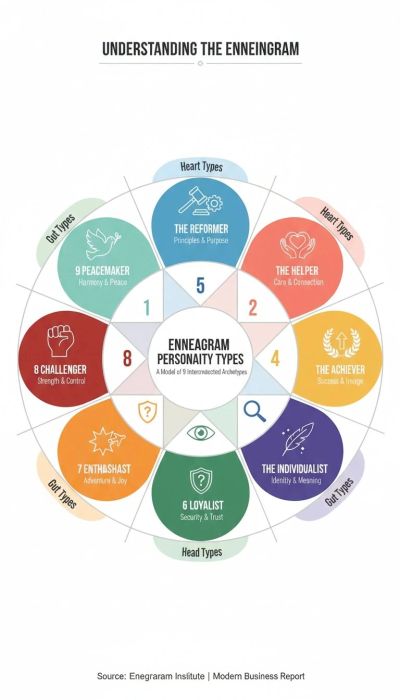
The Enneagram describes nine types, each with a core motivation, a core fear and characteristic patterns of thinking, feeling and behaving. Where DISC looks at behavior, the Enneagram explores why people act as they do, including under stress. It is a reflective framework, not a scientific measure.
WHY IT MATTERS
It’s hard to see motivation from the outside. The Enneagram helps people understand that colleagues who frustrate them are often acting from a different set of needs, not out of malice. That moves conflict from personal to understandable.
HOW IT WORKS
A questionnaire completed in advance suggests likely types. We then explore the descriptions together in a coaching session and test them against your real experience, so you arrive at a type you recognize as your own, not one that was assigned to you.
Emotional Intelligence (EI/EQ)
Self-awareness and relational effectiveness across five domains.
Best for:
Leaders building self-awareness and influence.
About 20 minutes online.
Optional 360 input.
One debrief session.
WHAT IT MEASURES
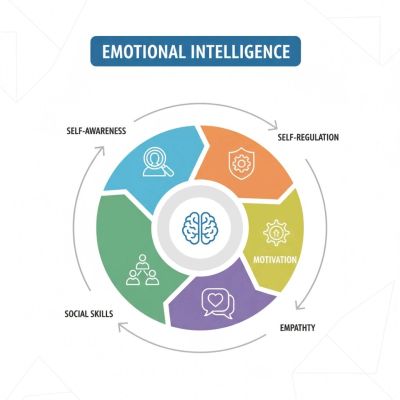
The five domains described by Daniel Goleman: self-awareness, self-regulation, motivation, empathy and social skills. With a 360 option, people who know you also complete the assessment, so you can compare self-perception with how others see you.
WHY IT MATTERS
Research links emotional intelligence strongly to leadership effectiveness, and it underpins trust and psychological safety. Unlike many traits, it can be developed. The 360 view is especially valuable, because the gap between how we think we show up and how others experience us is one of the most common blind spots in leadership.
HOW IT WORKS
You complete the assessment online. If a 360 is included, three to eight people who know you well complete an anonymous version. The report shows your scores beside the averaged scores from your contributors in each domain. In the debrief we focus on where the two views align and where they differ, since those gaps are often where the most useful coaching work happens.
Energy Profile

Your current energy across physical, mental, emotional and purpose dimensions.
Best for:
Individuals or teams feeling stretched.
About 10 minutes online.
One review session.
WHAT IT MEASURES
Current energy across four dimensions: physical, mental, emotional and purpose. The combination of energy level (physical and mental) and quality (emotional and purpose) places you in one of four zones: High Performance, Burnout Risk, Recovery or Depletion. Unlike other assessments, it captures a current state, not a stable trait. Both individuals and teams can be assessed.
WHY IT MATTERS
Energy shapes performance, decisions and relationships, and a capable person in the Depletion zone may not realize it. For teams, the aggregated results show whether performance pressure is outrunning the team’s capacity to sustain it. It makes a conversation about wellbeing concrete and data-led.
HOW IT WORKS
You take a short survey that captures how you feel now, so timing matters. We review the results in a coaching session: what’s driving your current state, what’s sustainable and what needs to change. For teams, each member completes the survey individually, and the combined picture feeds a facilitated team conversation.
Reflected Best Self

Who you are at your peak, through the eyes of the people who know you best.
Best for:
Clarifying and using your strengths.
6–10 contributors.
2–3 weeks from invitation to debrief.
WHAT IT MEASURES
A structured process that surfaces your strengths through the observations of others, not self-assessment. Colleagues, managers, direct reports, friends or family each share specific stories about a time they saw you at your best. The result is a set of recurring strength themes grounded in real examples, plus a written Best Self Portrait.
WHY IT MATTERS
Most people see their weaknesses more clearly than their strengths. This exercise reverses that. The strengths that show up most often in other people’s stories are frequently the ones you take for granted, and putting words to them gives you language you can actually use.
HOW IT WORKS
Contributors are invited by email and share two or three short stories in a confidential exercise. Their individual responses are never shared with you. AI analysis summarizes the stories into recurring themes and a written portrait, which become the basis for a dedicated coaching conversation.
Core Values

Identify, define and anchor your core values as a north star for decisions.
Best for:
Clarifying direction, big decisions, transitions.
2–3 coaching sessions plus reflection exercises.
WHAT IT MEASURES
Core Values is a reflective process, not a scored assessment. We work through five phases: Discovery (surfacing values through significant experiences), Shortlisting, Definition (what each value means in practice, including when you’ve honored it and when you haven’t), Stress Testing (applying values to a real decision) and Synthesis (a personal values statement in your own words).
WHY IT MATTERS
Clear values give you a durable guide in ambiguous or high-stakes situations. When you can say what a value means in practice and what it costs to violate it, decisions get easier and setbacks are easier to recover from. The result is yours, not assigned by an algorithm.
HOW IT WORKS
Over two to three sessions, with structured reflection between them on significant experiences, moments of pride and regret, and decisions that felt aligned or costly. The final output is a personal values document you can return to whenever you face a difficult decision.